 OpenX24
What a Shopify store actually costs in the UK
Ask three agencies what a Shopify store costs and you will get three discovery calls and no number. That is not an accident, and it is not always sinister — but it does leave you unable to compare anything. Here is what the work actually costs in the UK, across every route, including the bits that do not appear on a quote.
Key takeaways
- There are four routes: build it yourself on Shopify's own plan, a marketplace freelancer, a fixed-price productised service, or a UK agency at four or five figures.
- Our prices are published: £349 for a Starter store build (up to 20 products) and £899 for Growth (up to 100 products, custom homepage and sections).
- The costs missing from most quotes are Shopify's own subscription, your domain, apps and transaction fees.
- Ask for a written fixed price and scope before any call, and make sure the Shopify account and the domain are in your name.
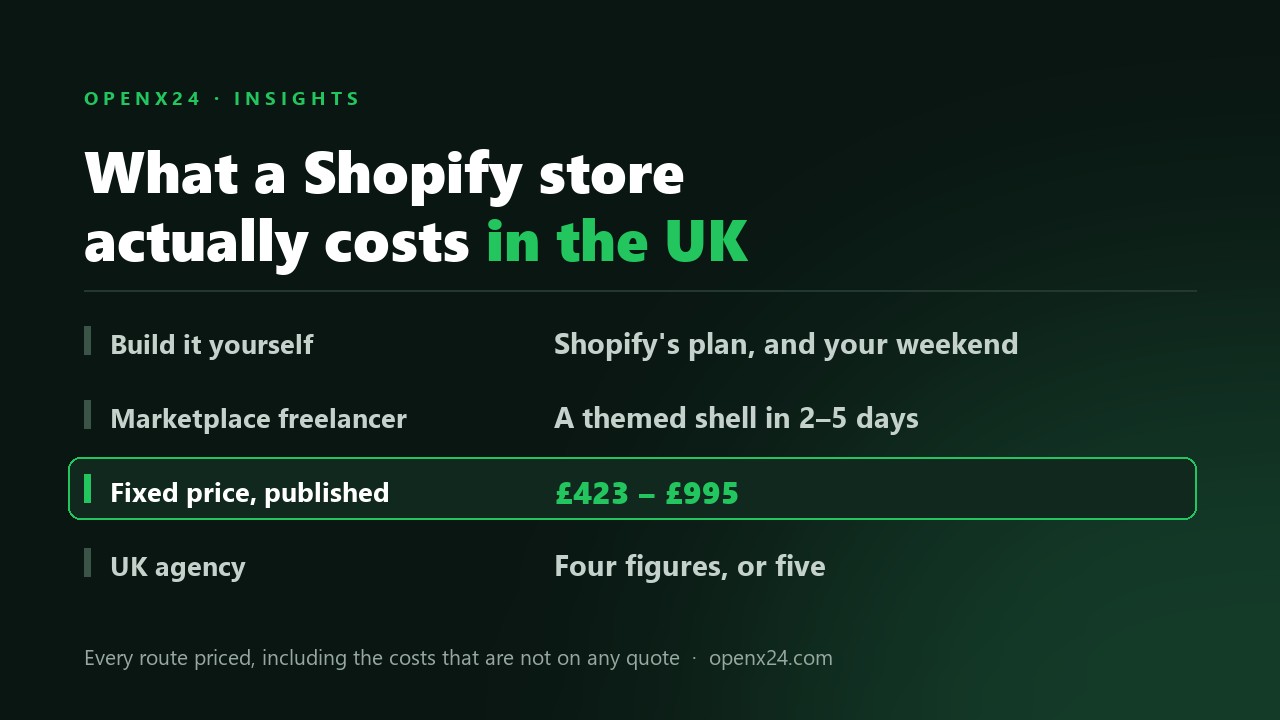
What does each of the four routes really cost?
Building it yourself is free apart from Shopify's own subscription. Shopify's Basic plan is the usual starting point for a small UK business, and its AI store builder will generate a themed shop from a description in minutes. If you have twenty products, decent photos and a weekend, this is a genuinely reasonable choice and you should not let anyone talk you out of it.
A marketplace freelancer sits at the bottom of the paid range. Fiverr gigs advertising a complete Shopify store start around the price of a weekly shop and go up from there, usually with a two to five day turnaround. What you get is a themed shell with your products in it. What you rarely get is anyone to ask when something breaks a month later.
A UK agency sits at the other end. Theme-based store setup from a small regional studio typically runs into four figures; a London agency doing custom work runs into five. That price buys discovery, design, project management and a team — which is worth it when the store is complex, and is money you cannot justify when it is not.
A productised service sits in the gap between the last two, which for years was almost empty. Fixed scope, fixed price, published up front. Ours is £349 for a Starter store build (from our library theme, up to 20 products) and £899 for Growth (up to 100 products, custom homepage and sections) — that is the whole number, and it is on the pricing page rather than behind a call.
Which costs are not in anybody's quote?
Shopify's own subscription is yours, paid directly to Shopify, every month, forever. Nobody building your store should be marking that up or hiding it inside their fee.
Your domain is also yours and also recurring. It should be registered in your name, not your developer's — more on that below, because it is the single most expensive mistake in this list.
Apps are where a store's monthly cost quietly doubles. A reviews app, a subscriptions app, an upsell app, an email tool: each looks like a small monthly number and together they routinely exceed the Shopify subscription itself. Before installing anything, ask what it replaces.
Transaction fees depend on how you take payment. Using Shopify Payments avoids the extra fee Shopify charges for third-party gateways, on top of the card rate you pay either way. This is not a decision to make casually at checkout setup time.
Why is the price usually hidden?
Some of it is legitimate. A custom build genuinely varies with scope, and an honest agency cannot name a number before knowing whether you have 12 products or 12,000.
The rest is sales strategy. A discovery call lets a seller anchor the price to your budget rather than to the work, and it filters out people who would have said no to the number. That is a rational thing for them to do and a bad deal for you, because you cannot compare three prices you were never given.
The test is simple: ask for a written fixed price with a written scope before any call. A business that can name both is telling you they have done this exact job before. One that cannot may still be excellent — but you are buying an unknown.
What drives the price up?
Product count and variants, more than anything. Twenty products with one option each is an afternoon. Two hundred with size, colour and stock levels per combination is a different job, and any fixed price that ignores the difference is either padded for you or a loss for them.
Photography. Most delays we would expect on a build are not technical — they are waiting for usable pictures. If you do not have them, that is a real cost, whether you pay a photographer or spend the weekend with a phone and a window.
Anything touching checkout. Subscriptions, bundles, deposits, trade pricing and B2B rules all add real work and real risk. Be suspicious of a cheap quote that shrugs at these.
Migration. Moving an existing store, with its orders, customers and URL structure, is not the same job as starting fresh, and the redirects alone deserve their own line on a quote.
Who owns the store once it is built?
Who owns it. The Shopify account should be in your name and on your card. The domain should be registered to you. Every credential should be handed to you at launch. If a builder disappeared tomorrow, your store should not notice.
This sounds obvious and it is the most common way small merchants get stuck: a domain registered in the designer's name, DNS scattered across accounts nobody has logins for, and a store that cannot be moved without finding someone who stopped replying two years ago.
Ask the question before you pay, and ask for the answer in writing. A builder who is fine with you owning everything will say so immediately.
What does a store cost after it is built?
A store is not finished when it launches; it is finished when somebody stops touching it. Prices change, products sell out, a payment provider updates its terms, an app breaks after a Shopify release.
You either do that yourself, which is free and takes your evenings, or you pay someone monthly. Both are legitimate. What is not legitimate is a monthly fee with no stated scope — ask exactly what hours or work it includes, and what happens when you need more.
The most repeated complaint from small merchants who buy a cheap build is not the price. It is being handed the keys and never hearing from the builder again. Whatever you pay, ask what happens in week six.
How do you compare two quotes honestly?
Put them side by side on the same five things: what exactly is delivered, when it is delivered, who owns the accounts, what happens if the date is missed, and what a change costs after launch.
A quote that answers all five in writing is comparable. One that answers none is not cheaper or more expensive — it is unknown, and unknown is what you are trying to remove.
If a builder will not put the fifth one in writing, assume changes are billed at whatever seems fair at the time.
What to do next
Decide first whether you actually need a builder. If you have twenty products, good photos and a free weekend, Shopify's own builder will get you selling and you should keep your money. If you would rather it were done properly and handed over working, get a written fixed price with a written scope before any call — and check that you own the Shopify account and the domain. Our prices are published on the pricing page so you can compare them against anything else you are quoted, including the option of doing nothing.
Want this handled for you?
Tell us what you sell and we'll send a fixed price and a live date within 24 hours. Free, no call needed.
See What I Need →Common questions
Sometimes, genuinely. A themed shell with your products loaded is a real deliverable, and if that is all you need it is good value. The risk is not quality on day one, it is week six: no documentation, no one to ask, and often no clarity on who owns the accounts. Ask those questions before you judge the price.
A straightforward store from an existing theme is days, not weeks — the build itself is rarely the slow part. What sets the real timeline is how quickly you supply products, photos and your delivery and returns terms. Be wary of anyone promising you are taking card payments by a specific date: that depends on Shopify verifying your business and on a new domain propagating, and neither is in the builder's control.
Selling through a marketplace or social media costs nothing up front and takes a cut of everything, plus you do not keep the customer relationship. Your own store costs a monthly subscription and whatever the build costs, and the customers are yours. Most small sellers end up doing both — the question is usually when to add your own store, not whether.